

The short version
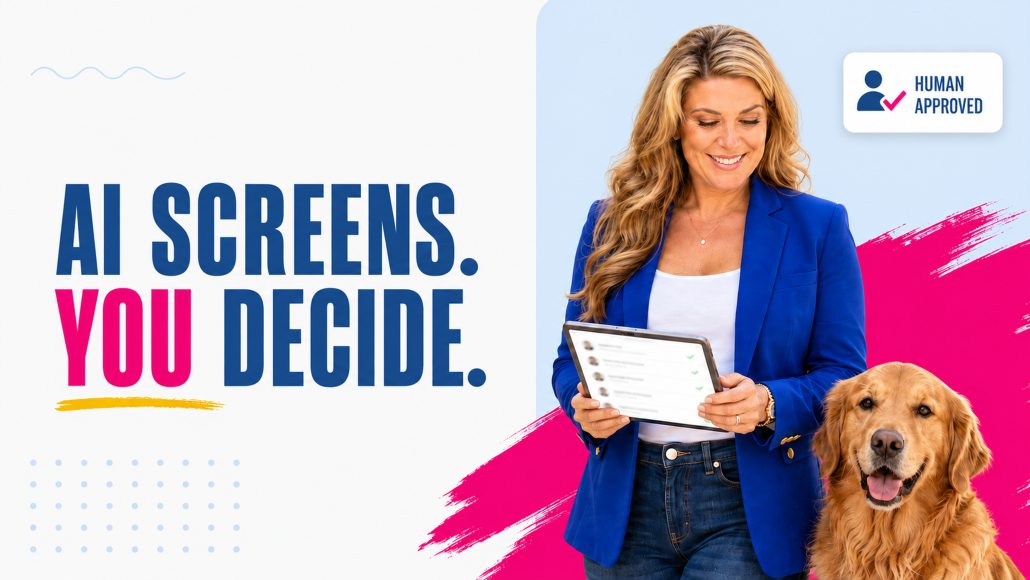
Quick answer: AI hiring for pet businesses works best when AI handles the repetitive preparation while you keep every decision that requires judgment. Use it to organize your ideal-candidate criteria, strengthen the job post, build consistent interview questions, summarize your own notes, and draft candidate follow-ups. Keep a real person responsible for screening decisions, interviews, accommodations, and the final hire.
Stop handing AI a stack of applications and asking, “Who should I hire?” That shortcut can send your whole hiring process sideways.
AI can absolutely help you hire pet sitters and dog walkers faster. Your messy brain dump can become a real job description. Every candidate can get the same core questions. After five interviews, AI can organize the notes when everybody is starting to blur together.
But the human part stays in the room.
I built and sold a nationally award-winning pet care company, and I have been in business since 2002. Hiring got better when I stopped treating it like a gut-feeling event and built a process around it. AI makes that process faster. Your process still has to exist first.
Why AI Hiring for Pet Businesses Needs Its Own Rules
A pet sitter is walking into a client’s home, handling keys and alarm codes, driving between visits, following medication instructions, and making judgment calls around living animals. Your job post can attract someone. A résumé can show experience. Neither one proves how that person responds when a dog slips a collar or a client changes instructions at the last minute.
That is why your 10-Step Jump Hiring Method stays in charge. AI can support the steps. It does not get to erase them.
The demand behind this is real. Google Ads currently shows 100 to 1,000 monthly searches for “AI hiring,” and the U.S. Chamber of Commerce reports that 57% of small business owners believe AI can help them compete with larger companies for talent. The pet-business version is still wide open. Most of what ranks today speaks to recruiters, software companies, and corporate HR teams. The owner hiring a dog walker who may be alone inside a client’s house tomorrow morning needs a very different answer.
This post sits under two bigger systems. The hiring hub owns the full method. The AI for Pet Business Owners hub helps you choose and direct the right tools. Here, we are connecting those systems at the exact points where AI can save you time without taking over your judgment.

Hiring is one of those things that gets expensive when you learn it through trial and error. Inside the Jump Mastermind, Bella helps you build the actual system around your real team and your real business. Come see what’s inside.
The 5 Hiring Jobs AI Can Help You Do Better
1. Turn Your Brain Dump Into a Real Role
Most hiring problems start before the job post ever goes live. The owner knows she needs “help,” but the role is still a pile of loose tasks in her head. Morning dog walks. Cat visits on holidays. Maybe medication. Definitely weekends, except nobody has decided how many.
Talk the whole mess out loud. Tell AI what your busiest week looks like, which visits are hardest to cover, what schedule gaps keep repeating, and what a reliable person has to be able to do without you. Then ask it to separate the brain dump into responsibilities, required availability, physical demands, trainable skills, and deal-breakers.
Read every line. Fix what it guessed. Use the result as your foundation, then approve the final role yourself.
2. Write a Job Post That Filters Before the Interview
A generic post attracts generic applications. “Must love animals” tells you almost nothing because every applicant is gonna say yes. Your real job post needs the schedule, the driving, the weather, the holidays, the emotional parts, and what makes your company worth joining.
Give AI your approved role criteria and your company’s voice. Ask it to write a first draft that makes the day-to-day reality clear. Then run the human test. Would your best current team member recognize this company? Would the wrong applicant realize the job is a poor fit before wasting your time? Episode 343 on the four systems in your hiring process covers the earlier AI work around job ads, offer letters, and open-ended questions. Use this page as the updated guardrail for where those drafts belong.
If the post sounds like every other pet business on Indeed, send it back. Don’t ever accept version one. Ever, ever, ever.
3. Build Consistent Scenario Questions
AI is terrific at helping you create scenario questions from your own rules. Give it a real situation such as a loose dog, a missing key, an incorrect medication instruction, or a client texting during the visit. Ask it to create one open-ended interview question for each situation and a simple list of what a strong answer should demonstrate.
This tightens the interview because every candidate gets the same core situations. You stop comparing one friendly conversation against one very formal conversation. You compare how each person thinks about the actual job.
Keep the questions job-related. Have an employment professional review anything you are unsure about before it reaches an applicant.
What Is AI Telling Pet Parents About YOUR Business?
Your next great employee will research you too. Find out what ChatGPT and Google AI are already telling people who search for your business… free, straight to your inbox.
4. Organize Your Interview Notes Against the Same Criteria
Take the notes YOU wrote during each interview and ask AI to organize them under the role criteria you already approved. Availability goes under availability. The loose-dog answer goes under emergency judgment. The candidate’s questions go under preparation and interest.
Remove names, email addresses, phone numbers, home addresses, and other identifying details before putting interview material into a general AI tool. The U.S. Chamber’s small-business AI guidance warns owners to avoid uploading personally identifiable information because an AI platform may retain or use submitted data.
Use the organized summary to find the place where your notes are thin. Go back to the candidate when you need clarity. A tidy summary cannot repair a rushed interview.
5. Draft Fast, Respectful Candidate Communication
Hiring gets ugly when people sit in silence. A candidate interviews on Tuesday and hears nothing for two weeks because the owner is buried in visits. By then, the good candidate has moved on.
Create approved templates for interview invitations, schedule changes, follow-ups, rejections, and offer-next-step messages. AI can personalize the first draft from your notes without you rebuilding the same email every time. Review the tone, confirm every detail, and send it promptly.
Speed tells candidates something about how your company operates. So does silence.
Where AI Has to Stop in Your Hiring Process
Keep AI away from the final hiring decision. Do not ask it to decide who feels trustworthy, who “looks professional,” whose voice sounds confident, or which applicant seems most likely to stay. Those shortcuts can repeat bias, hide the reason behind a recommendation, and screen out someone who could do the job.
Policies belong in writing before the first shift. Put them in a pet business employee handbook your new hire can actually find.
The U.S. Department of Justice guidance on AI and disability discrimination in hiring explains that employers must evaluate whether hiring technology unfairly screens out qualified people with disabilities. The obligation does not disappear because a vendor supplied the tool.
I want you to draw one hard line: AI can help you prepare and organize. A human reviews the evidence, provides required accommodations, talks to the candidate, checks the references, and makes the call. The same boundary appears in the Pet Business AI Automation guide because hiring decisions belong in the human-review column every single time.
| Hiring Step | AI Can Help With | You Stay Responsible For |
|---|---|---|
| Define the role | Organizing your brain dump | Choosing the real requirements |
| Write the job post | Producing a first draft | Accuracy, voice, schedule, and expectations |
| Prepare interviews | Drafting consistent scenario questions | Keeping questions job-related and lawful |
| Review interviews | Organizing your own notes | Judgment, follow-up, and accommodations |
| Communicate | Drafting timely messages | Reviewing and sending every message |
| Choose the hire | Nothing | The complete decision |
How Does This Fit the 10-Step Jump Hiring Method?
AI does not become an eleventh step. It sits underneath the repetitive parts of the existing method.
Start with the full 10-Step Jump Hiring Method for pet sitters who stay. Use AI while you define the role, write the job post, prepare consistent questions, and organize your notes. Then use the process Bella teaches in Episode 461, 10 Steps to Hiring Great Employees so you do not skip from job post to gut feeling.
If you are hiring for a busy season, listen to Episode 466 on using AI before the hiring window closes. That episode covers the numbers, the job post, the pipeline, and the point where AI can save screening time. This page gives you the guardrails around that work.
Frequently Asked Questions About AI Hiring for Pet Businesses
Can a pet sitting business use AI to screen job applicants?
AI can organize information from applications against job-related criteria you set in advance. Remove personally identifiable information first, review the original application yourself, and keep the final screening decision with a person.
Should AI choose which pet sitter I hire?
No. Use AI to prepare questions, organize your notes, and point out where information is missing. A person must interview the candidate, consider accommodations, check references, and make the final decision.
What hiring tasks can ChatGPT or Claude help with?
They can help turn a role brain dump into organized requirements, draft a job post, create scenario-based interview questions, organize your own interview notes, and draft candidate communication. Every output needs your review before it enters the hiring process.
Is it safe to upload résumés into an AI tool?
Remove names, contact details, addresses, and other personally identifiable information before using a general AI tool. Check the tool's privacy settings and your own employment requirements before uploading any candidate information.
Can AI make pet business hiring less biased?
AI can help you ask consistent questions and compare notes against the same job-related criteria. It can also repeat or hide bias, so consistency does not remove the need for human review, accommodations, and professional legal guidance.
Where should I start using AI in my hiring process?
Start with the role definition. Voice-dump the schedule, duties, physical requirements, and qualities the job actually needs, then use AI to organize that information. Approve the criteria yourself before you write the job post or review a single applicant.
Use AI to make the process easier to run. Keep your judgment in every decision that affects a real person and your real clients. That is how you move faster without handing away the captain's chair. Always keep jumping.